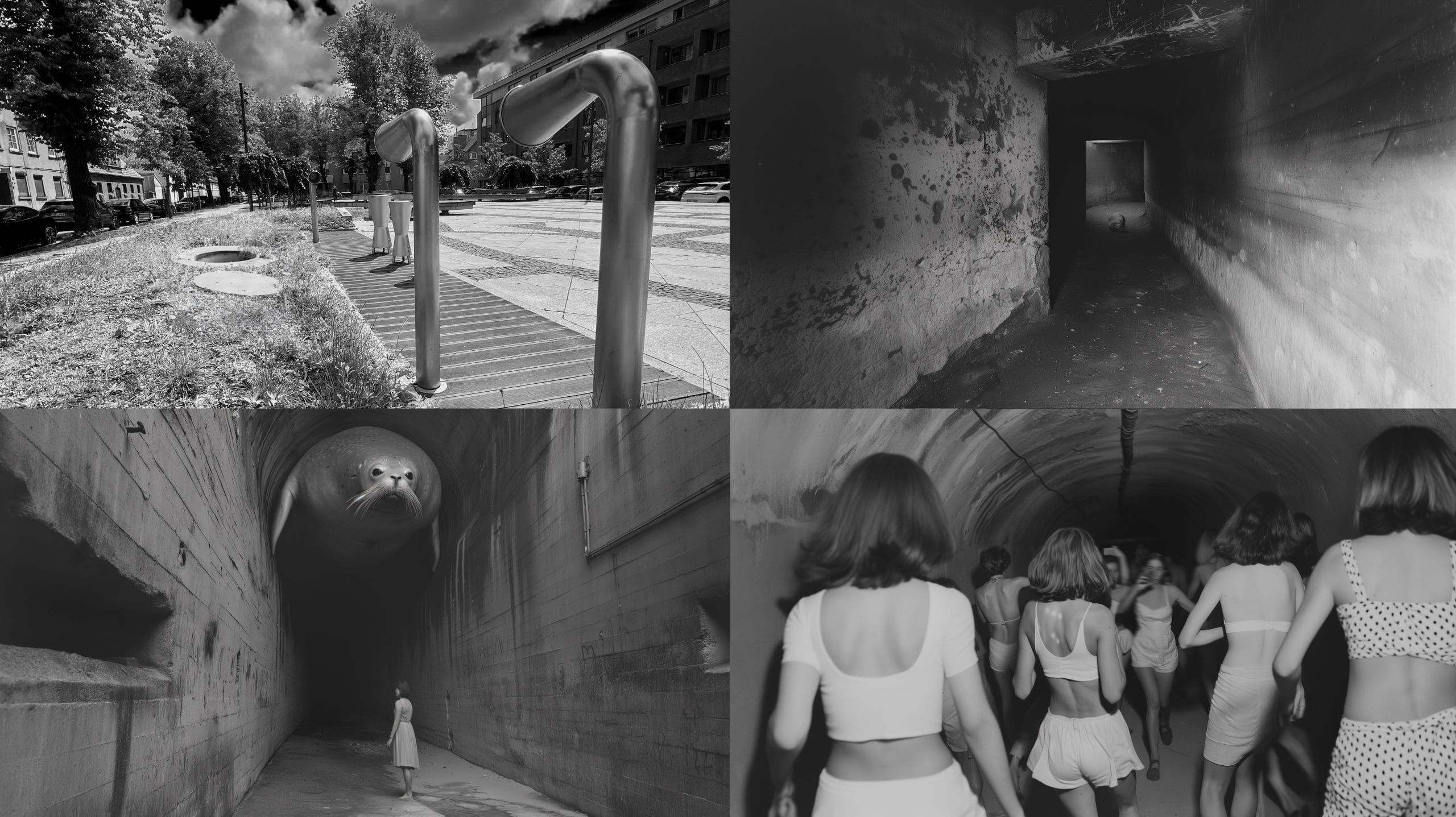
A blocked entrance to a tunnel, a shelter turret, a locked door or window in a building you cannot enter — such “unexplained” material features of the city are meeting points of rational and irrational knowledge, a cultural text of the city that can be read in many ways. This video work was inspired by the anti-aircraft shelters in Klaipėda that have survived since the Second World War (two of them right next to the railway station) and by the city legends about the labyrinths of tunnels connecting them. Facts of historical memory are interwoven with images of anxiety born of today’s realities: the pollution of the Baltic Sea, the climate crisis, the threat of war. This dream-logic image narrative reflects the collective imagination not only symbolically but also technically — ideas, keywords and photographs of the remains of underground shelters are reworked and mediated by various generative artificial-intelligence tools from an immense quantity of visual data.
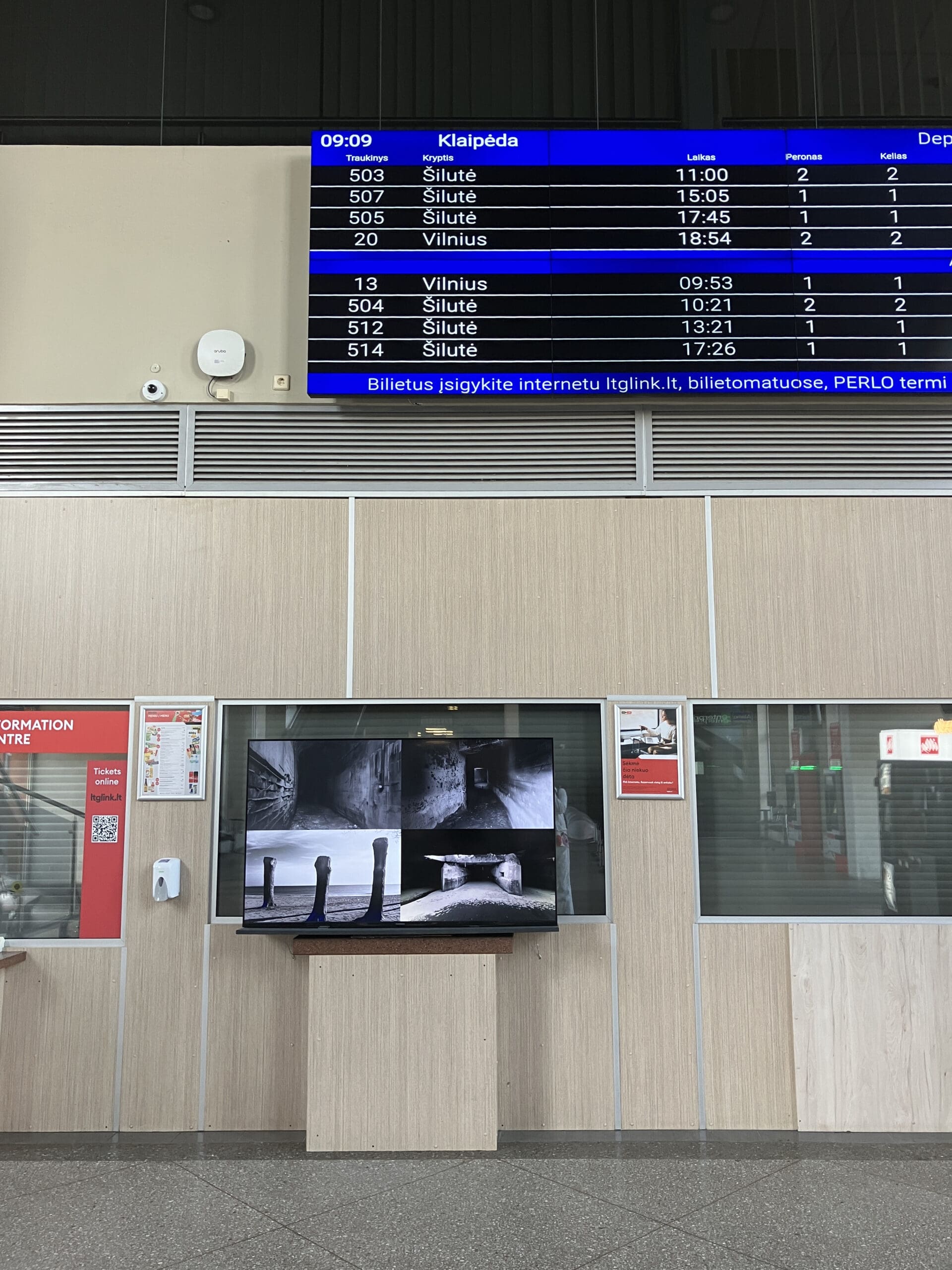
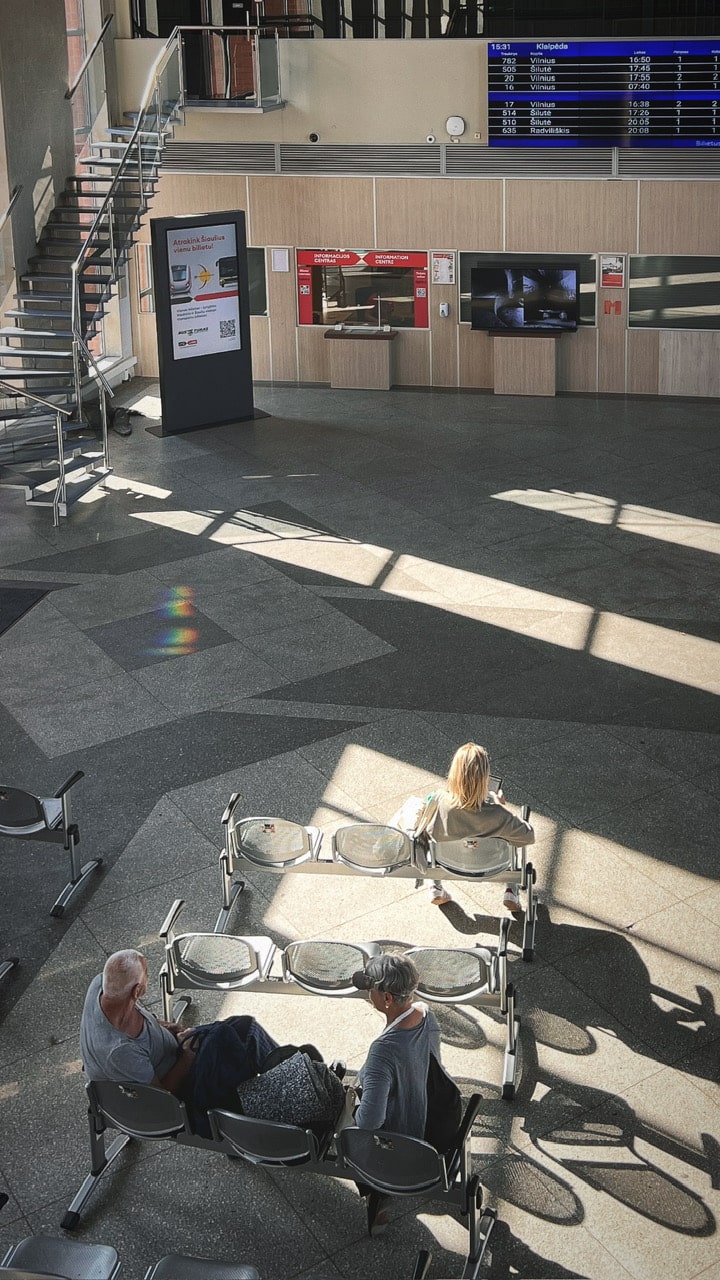
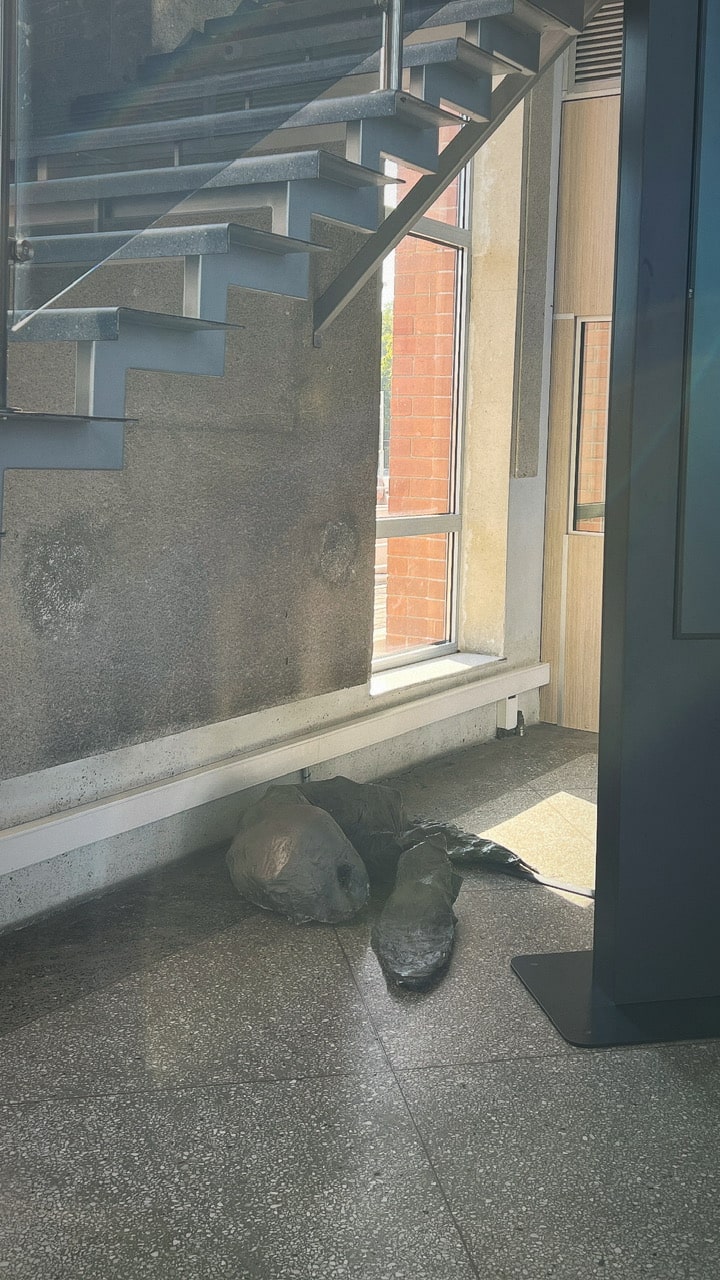
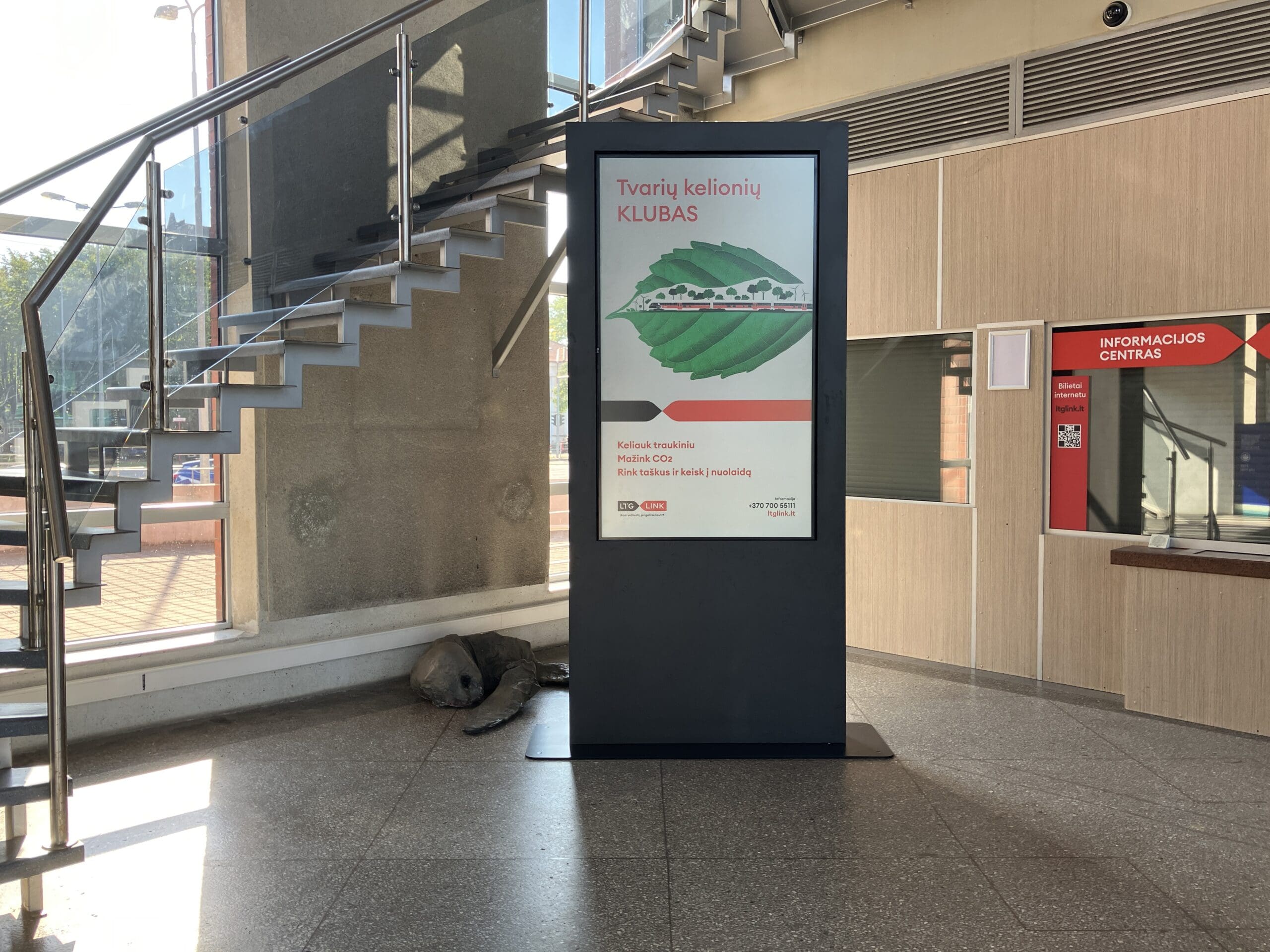
The video work intervenes in the waiting room of Klaipėda railway station, where the seating resembles an auditorium and the fragmented television screen recalls the images of surveillance cameras. To the chance viewers waiting for a train, it may seem that the parallel-reality image just seen on the screen was only a dream during a brief nap, or a glitch of their own imagination. But an object lurking in the corner, as if materialised from the screen, becomes a hint that a strict boundary between reality and imagination does not exist.
Agnė Gintalaitė, Shelter for Thoughts. Image: Agnė Gintalaitė.
The railway station is an especially important feature of every city, already charged with the natural anxiety of travel, the anticipation of adventure and an abundance of cultural imagery. It is a liminal space that captures the state of transition from stability to movement. In this in-between state a person steps back from everyday concerns, and the waiting for a journey, alternating with boredom, can manifest as free wanderings of thought. The railway station also evokes metro tunnels, which in wartime often become a refuge for city dwellers. On a sensory level the railway station is at once a zone of safety, of hope and of separation — there is always the chance of catching the train, but we always leave something behind, too.
Agnė Gintalaitė
Agnė Gintalaitė, Shelter for Thoughts. Photo: Paulina Pukytė.
Agnė Gintalaitė, Shelter for Thoughts. Photo: Agnė Gintalaitė.
Agnė Gintalaitė, Shelter for Thoughts. Photo: Agnė Gintalaitė.
Agnė Gintalaitė, Shelter for Thoughts. Photo: Paulina Pukytė.
Agnė Gintalaitė is an artist working with pre- and post-photographic processes, generative artificial intelligence, ready-made objects, moving image and sound. She graduated from the Vilnius Academy of Arts, studied psychology at Vilnius University, obtained a master’s degree in Cultural Studies from Vytautas Magnus University, and is currently a doctoral candidate in ethnology / cultural anthropology at the Institute of Lithuanian Literature and Folklore, a culture writer and a public-affairs commentator for lrt.lt. Her interdisciplinary creative strategy is characterised by a reflexive, research-based approach and a hybrid combination of scholarly and artistic research methods. Her areas of focus include conflicts between forms of knowledge and discourses, social norms and transgressions, mobility and migration, the phenomenology of human and non-human error, and generative artificial intelligence as an artistic medium.


'/%3E%3C/svg%3E)