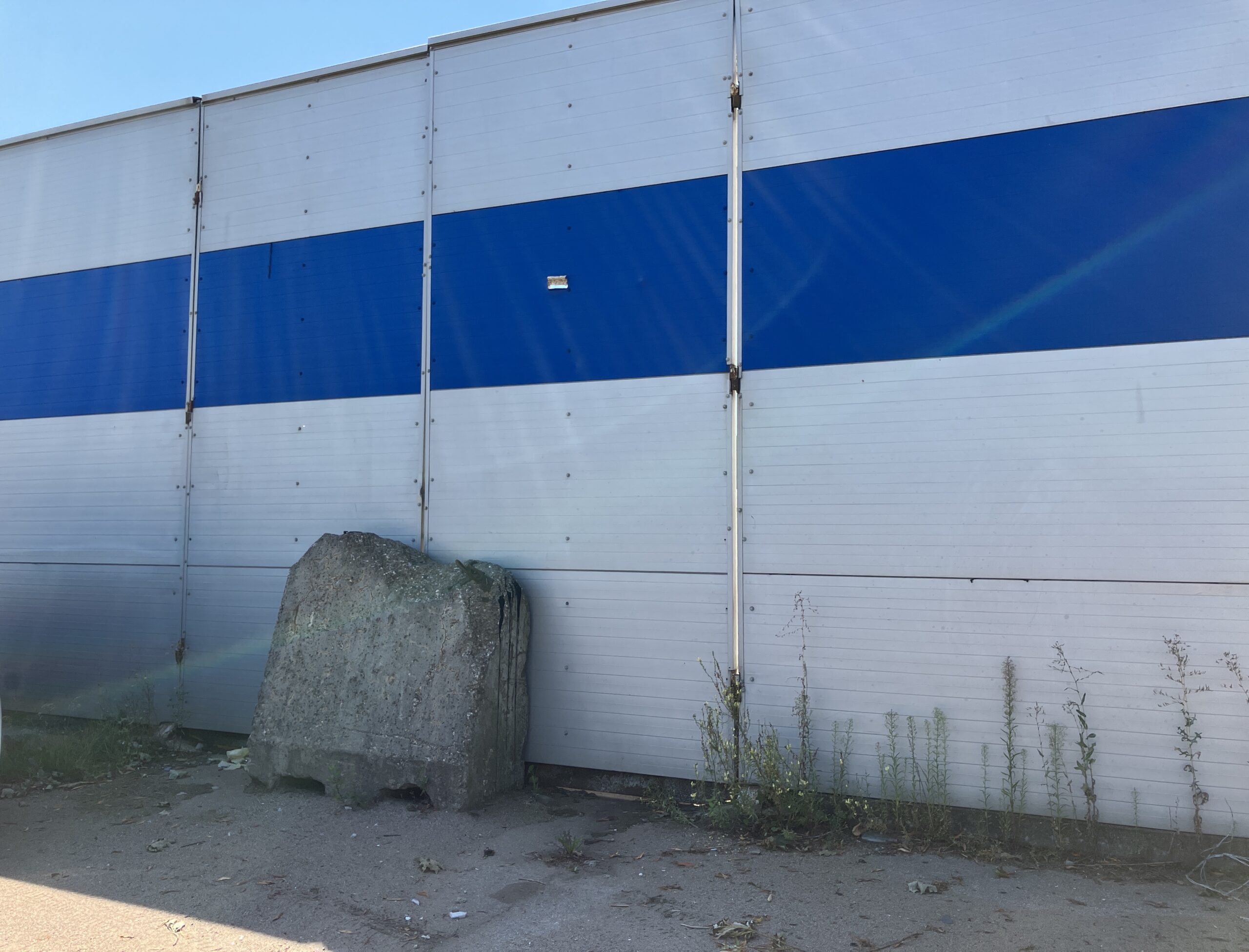
This work-situation recalls Kafka’s famous parable “Before the Law”, about a man who chose to wait at the gate of heaven for someone to open it, but never dared to open it himself. In the history of cities, closely bound up with the history of wars, gates carry a powerful symbolic meaning. In defence, gates were barred from the inside. This found situation, with a gate barred by a stone from the outside, seems to shift the burden of responsibility and of one’s relationship with the law onto society and passers-by, while at the same time emphasising the primacy of physical force and private interest over the power of decision. “A Stone on the Gate” raises important questions about private business’s attitude towards the public interest, about the privatisation of public law and an environment left to uncontrolled exploitation.
Auridas Gajauskas, Paulina Pukytė
Auridas Gajauskas, A Stone on the Gate. Photo: Paulina Pukytė
A Hole in the Fence, 2024
found situation
M-16 Scrap metal buyer, Minijos g. 162 / Rusnės g.
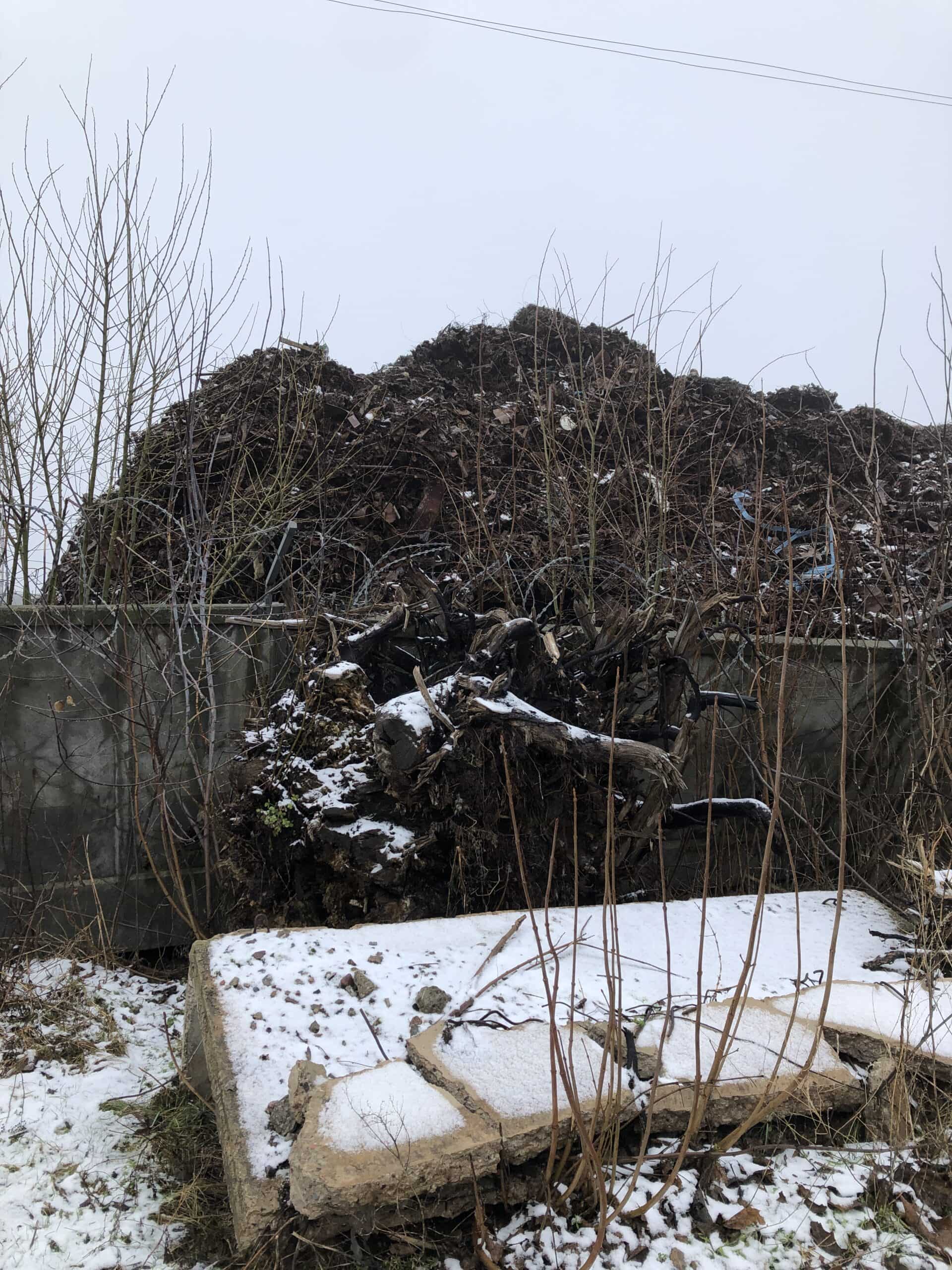
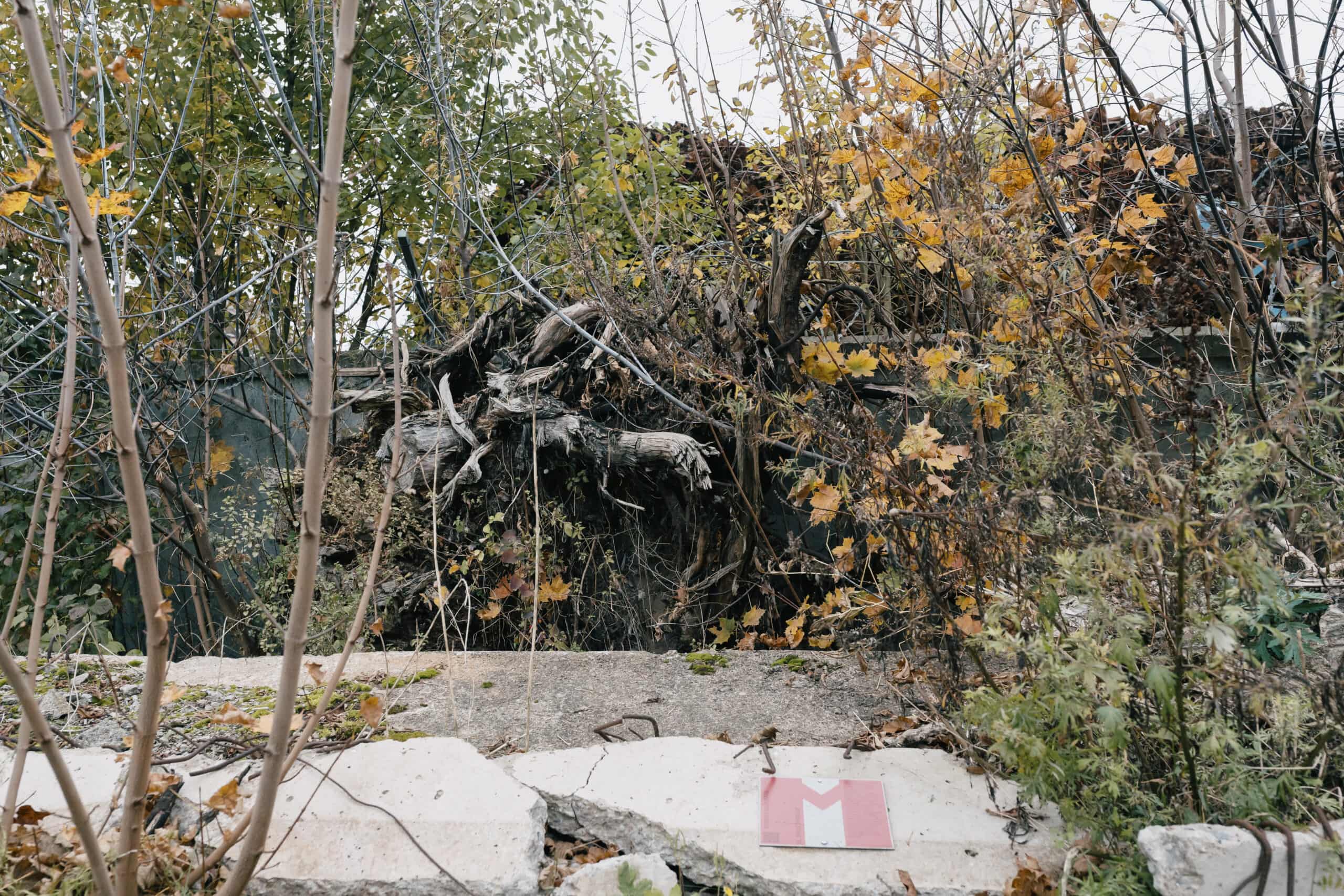
This work-situation could be described as a “third landscape” (Gilles Clément) — a landscape that joins human activity with elements of nature. Here the landscape consists of a mountain of scrap metal behind a concrete fence, a hole in that fence covered by the uprooted stump of a huge tree, barbed wire, a piece of concrete lying on the ground with protruding rebar, and all kinds of shrubs. Framing the found situation — turning it into an artwork and a metaphor — invites a critical gaze both at aggressive human activities that penetrate other communities and nature in order to appropriate, alter and exploit them, and at the manipulations used to justify such activities.
Auridas Gajauskas
Auridas Gajauskas, A Hole in the Fence. Photo: Paulina Pukytė
Auridas Gajauskas, A Hole in the Fence. Photo: Gediminas Sass
Auridas Gajauskas is a humanities scholar. For three years he was curator of exhibitions and the library at the Contemporary Art Centre in Vilnius. In recent years he worked at a reception centre for Ukrainian war refugees in Dresden, where he also carried out an ethnographic study of the centre. He is currently interested in the methodology of curating contemporary art, the philosophy and theory of the social sciences, and the possibilities of infrastructural activism in art and in resistance to social and cultural exclusion.