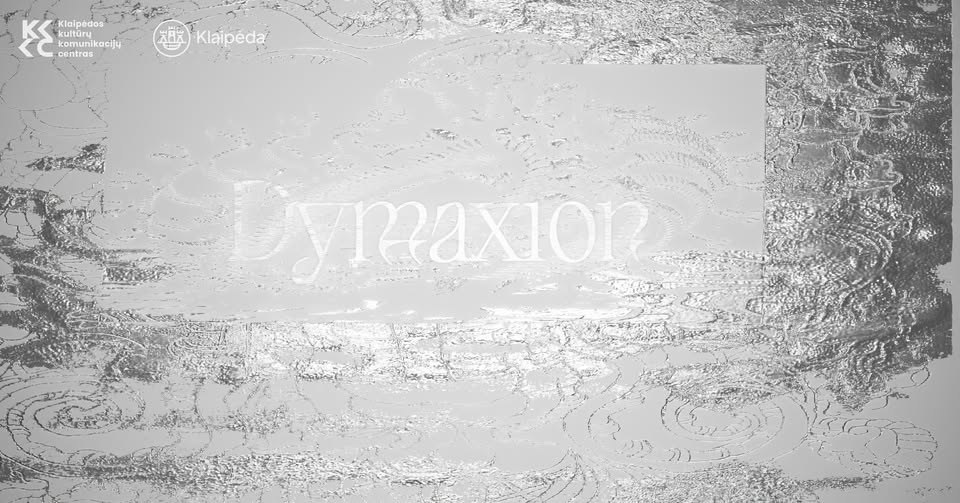
The group exhibition Dymaxion opens on 9 May at 5.30 pm at the Klaipėda Culture Communication Center (KCCC) and runs until 8 June. Participating artists: Agata Orlovska, Deividas Valentukonis, and Mantas Valentukonis.
Coined by American architect, inventor, writer, and futurist Buckminster Fuller, the term dymaxion means maximum efficiency with minimal energy use. Fuller’s most iconic creations, the Dymaxion House and the Dymaxion Car, remain enduring symbols of sustainability. This concept is reflected in the structure of the exhibition, where technology and art converge to create new forms of interaction and symbolism.
After this exhibition ends, the gallery will close for renovation. The dismantling of the ceiling has revealed deep layers of technical and industrial architecture: tangled networks of metal mesh, cables, ventilation ducts, and aluminum structures. These elements have become not only part of the visible environment but also an active contextual component. The exposed infrastructure reflects the convergence of digital and physical realms and symbolizes post-industrial architecture — a recurring metaphor for virtual reality.
Stanisław Lem’s Solaris and its depictions of an extraterrestrial ocean – an organic, ever-shifting intelligence – resonate with the themes of this exhibition. Lem’s vision echoes 18th-century theories by Franz Anton Mesmer on animal magnetism: a vital energy that flows between all living beings and can be harnessed for healing. Mesmer claimed that a fluid, continuous substance permeates the universe and earthly organisms, transmitting the influence of celestial bodies – such as the Moon, Venus, and Jupiter – not only to ocean tides but also to human emotions and decisions.
In this paradigm, aluminum emerges as a perfect metaphor. As one of the key metals of the technological world, it is used in spacecraft, computing systems, communication networks, and the infrastructure of virtual reality. Aluminum also carries an alchemical dimension: light yet strong, it evokes esoteric metals like mercury, historically linked to ideas of transformation and perpetual metamorphosis. In this context, aluminum becomes a post-industrial artifact. Through its properties of melting, forming, and reflecting, it brings questions of cybernetic architecture and industrial memory to the surface of the material landscape. The reliefs, made from melted car parts, become new layers of informational media, connecting with the abstraction found in Mantas Valentukonis’ paintings. These works attempt to reference the painting as a surface, while also generating their own logic of color codes, textures, translucency, and reflection to construct narrative.