


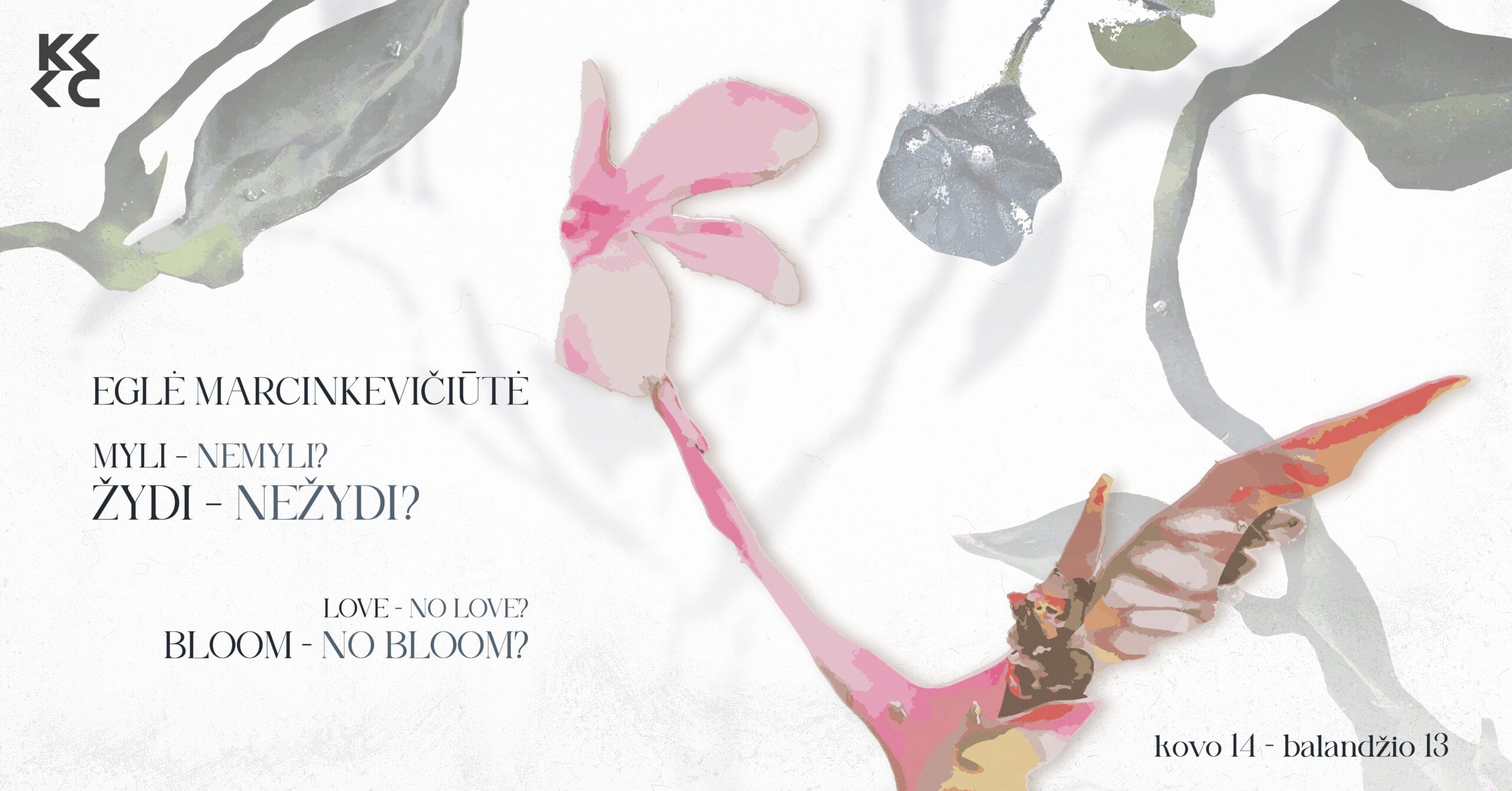
Eglė Marcinkevičiūtė. They love me – or love me not? They bloom – or they don’t?
They love me – or love me not? They bloom – or they don’t? In these questions, we seem to find a visual vocabulary of romance – not only in the allure of blooming flowers but also in how vulnerable we are when in love.
In my work, I explore the boundary between natural and artificial, shaping a visual dialogue about what is real, constructed, or merely imitated. In this exhibition, I invite you to perceive the phenomenon of growth not as a natural state but as a process that can be altered. Throughout it, I prevent my plant-based surfaces from decaying and meeting a cruel end. However, my creations are permeated with environmental anxiety: at times, they transform into simpler, even mocking constructions of striking colors and shapes.
Installations of paintings, sculptures, and video projections resemble intricate plants; a kind of tension emerges between the organic and the artificial. Industrially manufactured structures are combined with the surfaces of traditional painting.
Such objects raise questions about the boundaries of authenticity. Abstract depictions of plant forms transform into impersonal industrial plastic and metal components, as if bolts and wires turn human creativity into man-made industrial products.
Slowly, the artificial flower becomes an independent entity, departing from its limited traditional habitat and acquiring a new context. The occasional emergence of therianthropes – mythical beings with human, natural, and animal traits – points to the blurred boundaries of imagination. The final result is a meticulously constructed and stylized hybrid flower within a synthetic reality. Sooner or later, such an industrial plant, imbued with irony, draws the industrial human eye to an environment of human creation.
These plant-themed paintings fit into the overall scenography of the installation. Many of these motifs linger and lurk, some observing from a distance, while others merge, split, or freeze before foreign bodies menacingly target their center. One can sense that the implied threat is an imitation, its form softening the gravity of the situation. It appears primitive and familiar, perhaps a little ironic and reminiscent of a pre-orchestrated game, which raises the question: they bloom – or they don’t?