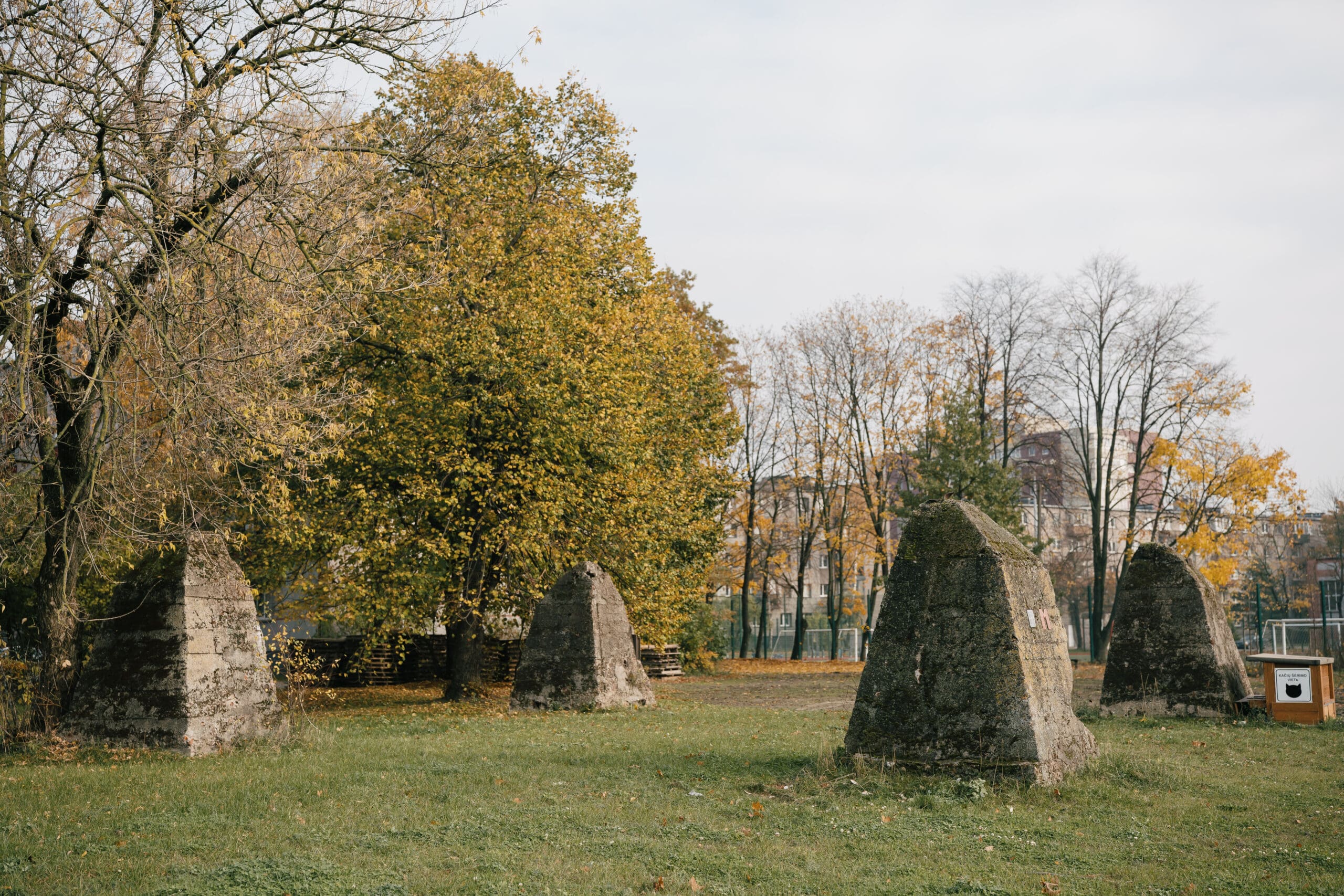
It is said that as early as the 13th century Klaipėda stole the beacons depicted on its coat of arms from Königsberg (not the beacons themselves, only their image; how copyright worked at the time is not known), because it had no beacons of its own yet. In order to refute the myth of “theft”, unflattering to Klaipėda and its coat of arms, it was decided to return to Königsberg the image (not the beacon itself) of the beacon that had stood on this spot since 1852 – because if you return something, it means you did not steal it but merely borrowed it, even if a hundred years ago (in this case seven hundred). Since the beacon can no longer be seen here, and the purpose of a beacon is to be seen, it follows that its image has already been returned. In gratitude for such a fine, if somewhat belated, gesture, Königsberg presented Klaipėda with two cats, which settled beside the foundations of the returned beacon. By this reciprocal act Königsberg also wished to remind Klaipėda that it had borrowed two beacons but returned only one. On Klaipėda’s side, one might plead in mitigation that back in 1777 Klaipėda also returned to Königsberg the philosopher Moses Mendelssohn, grandfather of the composer Felix Mendelssohn (author of the famous wedding march), by refusing to let him, a Jew, settle in Klaipėda.
In telling this urban myth, the artist draws attention to questions of city image-making and of the participation of citizens in it, as well as to the problems of decisions about “decorating” and “cleaning up” the city and the (non-)survival of historical and cultural heritage.
Paulina Pukytė
Sofija Baldauskaitė, The Returned Beacon. Photo: Gediminas Sass
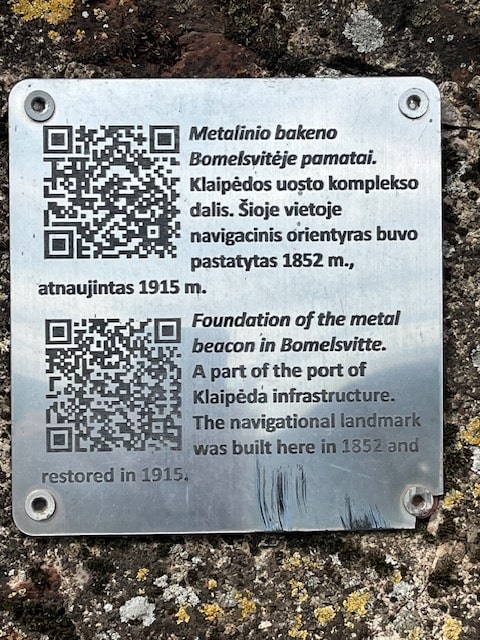
Information on the foundations of the Klaipėda beacon.
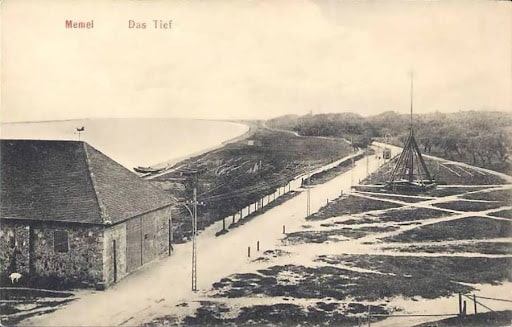
The beacon in Klaipėda. Photo: postcard from the internet
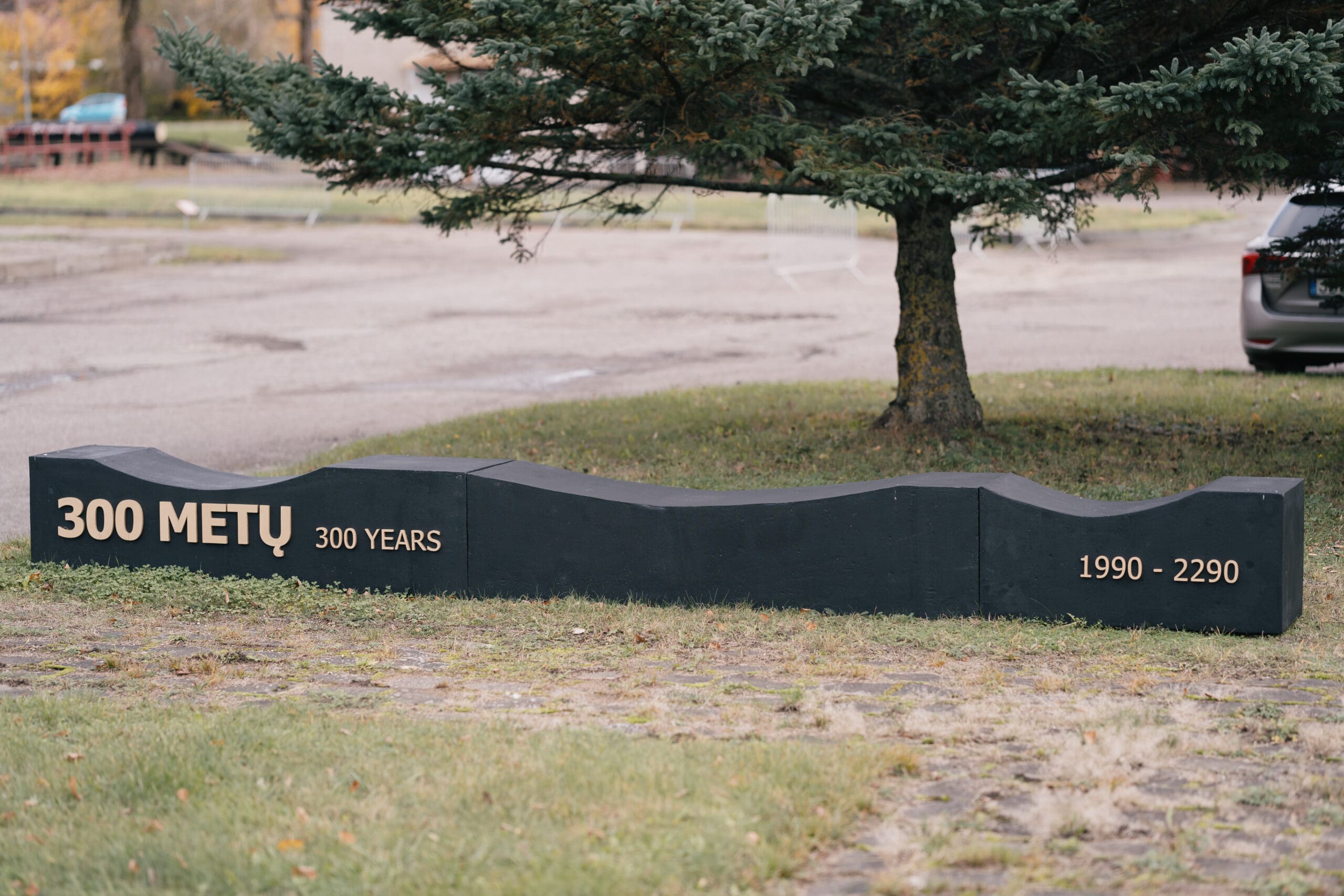
300 Years. An Artistic Accent of the Future (Temporary), 2024
object; an inexact copy of one element of the “Timeline” in Danė Square; polystyrene foam, paint, 50 x 50 x 500 cm (horizontal);
distances measured with bodies and objects and the future calculated by Juozas Laivys and Paulina Pukytė; copy made by Juozas Laivys
M-3 “Klaipėdos energija” site, Danės g. 8, next to Building M
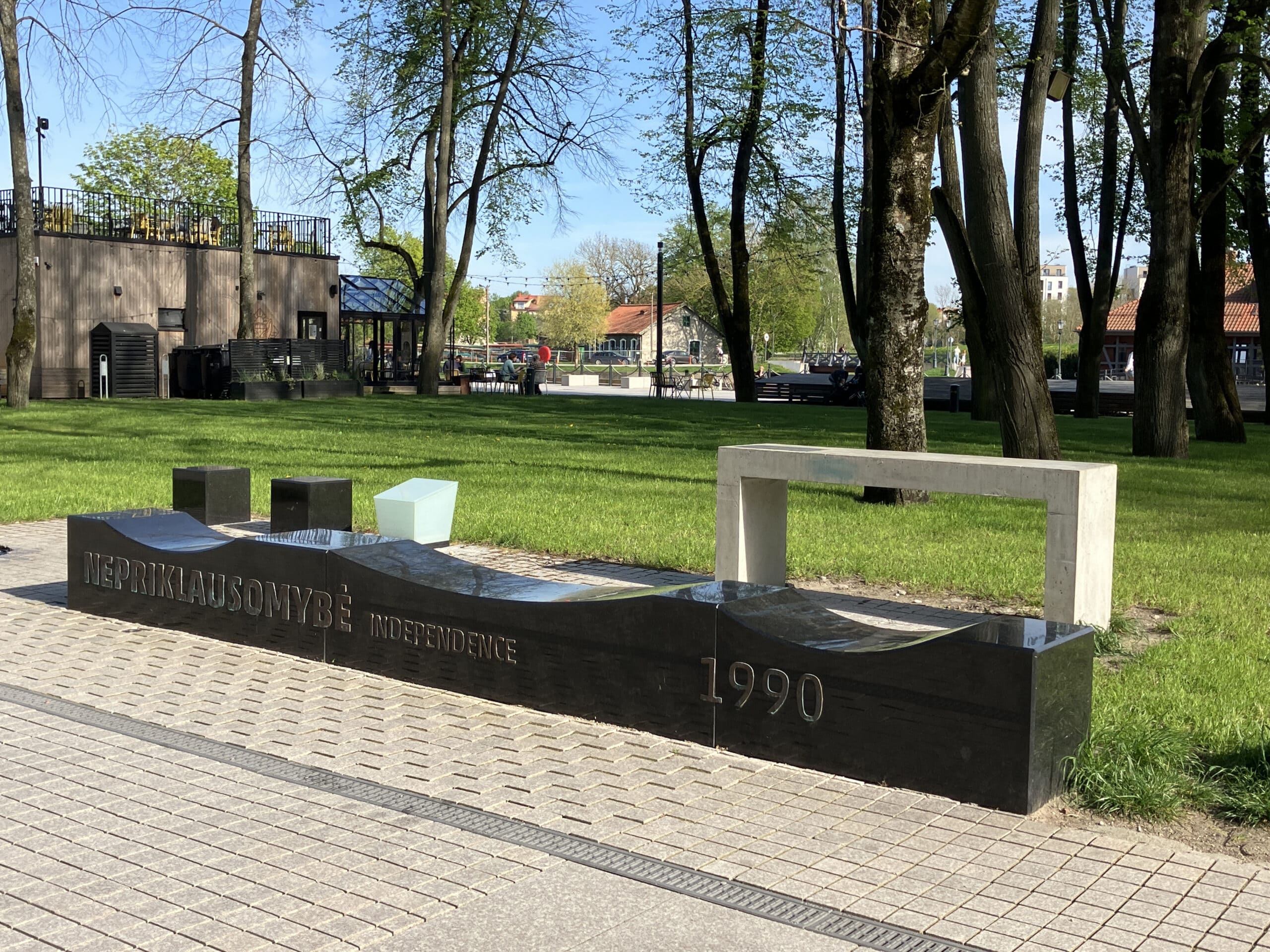
The Klaipėda timeline on the Danė embankment. Photo: Paulina Pukytė
Sofija Baldauskaitė, 300 Years. Photo: Gedminas Sass
In the sculptural and architectural “Timeline” of Klaipėda’s history in Danė Square, dedicated to the centenary of Lithuania (its authorship is disputed, since it is unclear what matters more – the idea, the design or the execution), the distance between the Soviet period and the restoration of Independence is 55 years and roughly 75 metres (a ratio of 0.733). From Independence to this spot is about 410 metres, so if history rolls on in a straight line and the same years-to-metres ratio is applied, it is precisely here that the restoration of Independence would turn 300 years old. This artistic accent marking a future historic anniversary – “acceptable to everyone” because it “does not stick out”, black yet optimistic, seen somewhere before but by no one knows whom, and, above all, donated – tied to the city’s history and image, based on the ratio of distance and time and predicting what will happen in the future, will never live to see its own moment, because, long-lasting though it is, it is temporary.
The work raises questions important to the culture of the city: about the problems surrounding decisions on “decorating” public spaces and commemorating memory, about the value of artistic ideas, and about the ways so-called urban accents (public decorative art) come into being in a city, and their authorship. Does history merely repeat itself?
213 feet (1 foot = 3 paving tiles = 2 iPhone SE lengths and one width) = 0.352 m x 213 = 75 m
75 metres = 55 years (1945–1990), 410 metres = 300 years (1990–2290).


'/%3E%3C/svg%3E)